Wednesday, November 4, 2015

Story Boards

Anna and I have decided to work in a group to help Chastity break out from being shy, to keep her independence and feel comfortable around other kids.

To start, we have worked on story boards that explain different scenarios she may find herself in. In total we have 10 boards. Together, we worked on the scenarios and what they would be, but then split up the 10 to draw each of them. Below are scanned images of what my boards came to look like along with a brief description under each panel and a "Why" statement at the vary bottom.


During class today, we also thought about Chastity's life in terms of the article “psychological sense of community.” 

Our results are as follows:

While at the Pool:

Membership: 
  • who intends to swim based on their attire, while others are merely  are there to watch.
  • lifeguards

Boundaries:
  • being aware of who can swim independently and who cannot, this is also apparent by swim gear.
  • rules according to pool standards
  • shallow water v deep water
  • lifeguards

Influence:
  • helping others in their swimming process
  • encourage other children to play a game/race
  • teasing whether it is in fun or mean terms

Integration/Fulfillment of Needs:
  • having a choice in one’s role at the pool
  • being active and participating in a social activity

*This is what Chastity truly needs to work on. She is independent but when surrounded by people she shuts off and her mother fears she will not maintain that sense of independence.

Shared Emotional Connection:
  • playing with other members at the pool
  • leader v followers

Tuesday, November 3, 2015

Virtu/Real Relationship Building

For the next project we have been presented with, we are once again working to find a way to better the community. In this case, our targeted audience is a child and his/her parent trying to figure out how a gap or place for improvement can be addressed. This could be to improve the relationship, a safety concern, or goals/dreams they have. 

To start, I chose my particular audience to be based off the lives of:

          kristyn (mom) and chastity (daughter)

To better understand who they are and their lives, desires, wishes and goals, I watched their videos and created mind maps based on their information. The maps, although address four different topics, are all related. This is why we worked on transparent paper, so that when laid over one another, connections could be made.

The maps explain the ideas as follows:

People: Their name, age, knowledge level relative to school and life topics (reading, school subjects). A mind map describing the child and their life.

Places: Where all of the relevant locations this child finds themselves that has a relationship to the mothers concerns.

Objects: Things used or associated with the child

Activities/Social Interactions: What communities the child is a part of. 


Monday, November 2, 2015

Reflection

Compared to typical in-studio projects, how did the realistic nature of this project (for the united way, viewed by the public, a budget, etc) impact your work? (for example, were you more motivated to do good work, or less? were budget and other constraints good or bad?)
Having to keep in mind that the nature of the project was not simply for a portfolio ( a student driven goal) but rather, for the community, was challenging and rewarding in its own nature. As a group of student graphic designers, not used to a budget or public viewing, we had to keep an open mind and remember that we were designing to benefit the community. Their needs and wants came first to ours. And honestly, I loved that feeling: helping others through design. Having the budget put the work, time, and production into perspective. Having to problem solve pushed limits and showed us just how much we could learn to "think outside the box."


How did the content impact you, compared to typical in-studio content? Did Erika’s involvement have any effect on your content understanding beyond your usual research process?
I loved having to approach this project with an open mind - a mind that really was new to the subject. I had to really dig deep to understand the information for myself, to then better communicate to others said information. It was a learning process in more ways than one. 
Having Erika's involvement had a large effect on the content understanding for it created a block to push off of. Her direction was exactly what we needed to better grasp the goals of the project. 
I do wish that perhaps we could have heard from others who were also involved, but overall, having Erika's input was very helpful!!

Friday, October 30, 2015

The finale product

For the final product, we gathered all of our class's information and compiled it onto a single presentation. I collected this information and designed the final pdf click-through. The slides were to be simple, not to distract from our product/exhibit design. 

Below are a few slides explaining our work. We showed a mockup of the 7 sections in the auditorium space, then flat art, followed by a closeup (shown below).

I think that the overall presentation went really well. It was great having Ella, Devon and Liz talk about the class's work - they did a wonderful job!

Overall, I am so proud of the class for bringing everything together. It taught me a lot regarding group work. It is a lot of work, but not only can you work to create a beautiful piece together, you learn to come together over a common goal: to help others and build a respect for all.


These are images from the actual presentation:

A suggestion from the class, I laser cut the Hard Choices title to then show Erika what the titles would look like. It was a great idea, and Hope then brought in cut paper to the size of the boxes in order to show the physical scale. I think it really helped to have this visual representation, for the computer mockups can only go so far to express the size of the displays.


The Final Countdown

I felt that as the project continued we started to find an identity for this exhibit that we could, almost, all agree on. Which, when you have a class of 20 people, that is pretty awesome. I am so proud of our class for coming together in the end and pushing through to create a final product I think most people felt excited for.

Below are a few of our final designs. Going back to our original groups, we were able to narrow down on information and divide and concur. Being an XD, I wrote information for my particular group (Hard choices made in poverty), the copy seen below. It was wonderful working with Ella and Haylee for they are both very hard workers and easy to talk too. They are always willing to go above and beyond what is expected of them, and never once did they question what we had to do, they simply did it.


In our XD groups, not only did we write content, but user-tested the information. It went surprisingly well as our assumptions were, happily, not entirely true. We figured that people would not be that knowledgable in the field of poverty, but all three that we interview, were. They were just unfamiliar with poverty in Douglas County.

We set up full scale posters, and had them fill our a questionnaire before and after they read the information to see what they had gained from it. Here was an example:


We learned from our test that we needed to be clearer in our information, and a little more precise about how the viewer was to interact with our exhibit.

There also needed to be an emotional take-away. A reflection or call to action. Even though we addressed this, after talking with Erika, the class found that we may have needed to spend more time on the call to actions. This was good to hear. There is always room to improve, and if our group's direction is chosen, it will be exciting figuring out just what to say.

Group #3

For the second stage of this project, we broke up into three secondary groups to narrow down on a graphics direction using the information pooled by the original teams. We approached this by looking into the audiences needs and our perception on what would be the best way to show the information  We ended up relying on materials and services we could get at the design school, such as wood, the laser cutter and letterpress.

Here is a bit of the presentation we put together for our class (below). I worked with Michelle M. to create the section dealing with health and poverty. She was wonderful to work with as her extra research allowed for us to experiment with our yarn idea, having the viewer follow the life of a person in or out of poverty. (explaining how health effects us all and can lead to financial strain.) I used her information to then create the visual look, basing it off of our groups mood-board.

I created each of the photoshop mockups shown below, imposing the documents and posters onto the photos.


Social Change

I love projects that focus on social change, impacting the community though graphic design. This is why I thoroughly enjoyed our project working with the United Way to help people understand Poverty in Douglas County. To me, graphic design is not just a means to a pretty poster, it is a tool we can use to better society.


For our United Way project, I started off working as an Experience Designer. I found that I learned a great deal regarding the users experience and how to approach a project, not based off of personal goals and desires, but rather, to address the intended audiences's wishes and expectations.

I then worked within a smaller group that focused on "hard choices made by those in poverty." And I was amazed at what we found. Perhaps my favorite part about this project was the research. I learned more about this subject than I ever would have on my own. And for that I am grateful.

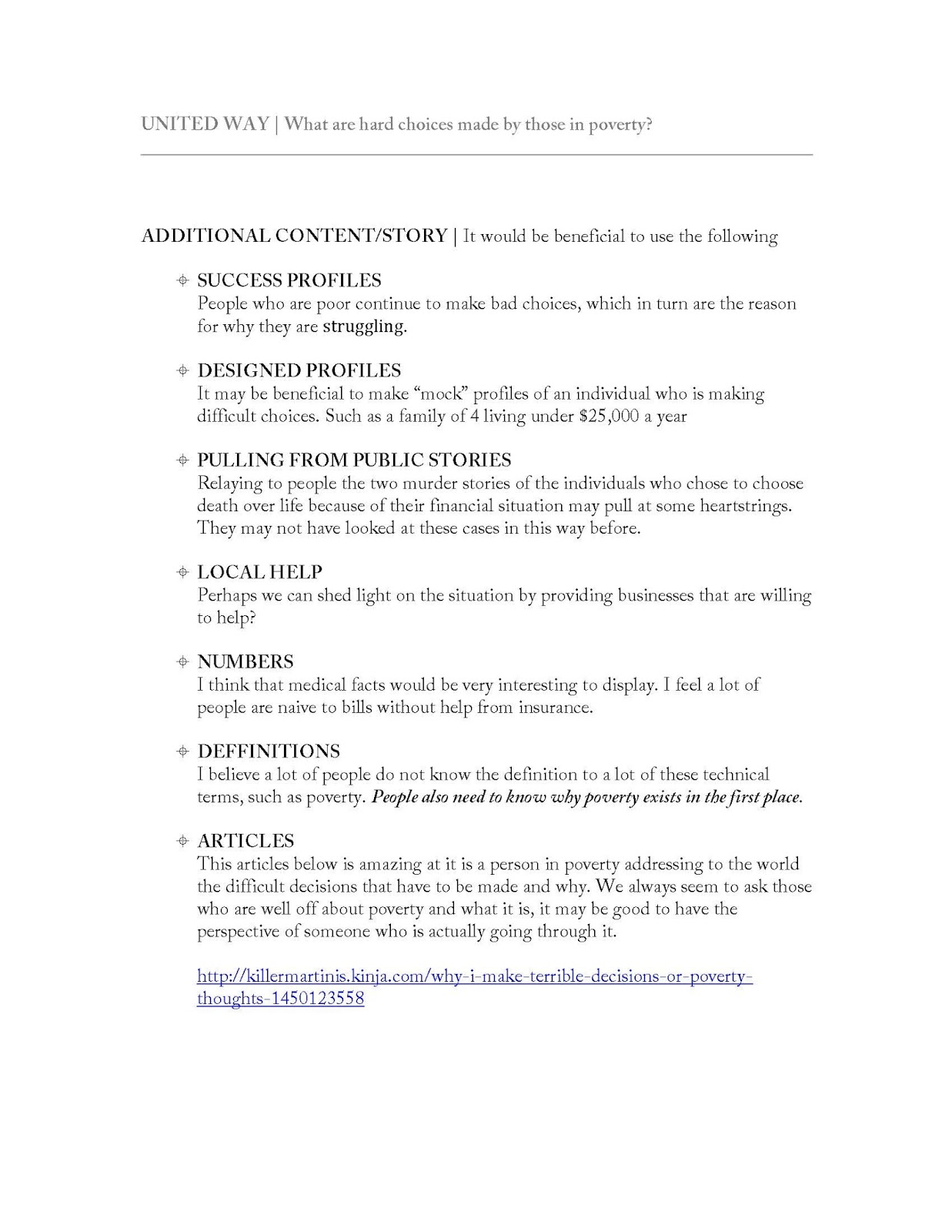
This is the initial information that I researched for our group: